• Skip to primary navigation
  • Skip to main content
  • Skip to footer

Commerce and Management Sciences World

Commerce, Financial Accounting, Human Resource Management,, Cost Accounting, Principles of Business

  • Subjects
    • Accounting
      • Financial Accounting
      • Cost Accounting
      • Accounting Information System
    • Principles of Banking
    • Introduction To Business
      • Introduction to Commerce
    • Auditing
    • Management
      • Principle of Management
      • Human Resource Management
      • Strategic Management
      • Organizational Behavior
      • Financial Management
      • Management Information System
    • Economics
    • Marketing
  • Miscellaneous
    • MCQs
      • Accounting MCQs
      • Auditing MCQs
    • Short Questions

What are the Costs? | Characteristic | Types | Indirect & Direct Costs

March 17, 2017 By Salman Qureshi

What are the Costs?

The costs correspond to all the costs incurred by the company during the whole process of production of a good or service.

Characteristics of Costs

Costs refer to all costs and expenses incurred by a company in the process of producing a product or service dedicated to sales. The activities of the company require a certain number of resources, for example, financial or human, which are considered as costs. A cost can be a cost price, a purchase cost, or a cost of production for example.

This term is used in management accounting (or cost accounting).

You may also like to read

  • Difference between Costs and Expense
  • What is Cost Accounting -Types and Elements of Cost

The different Types of Costs

There are 4 types of costs: fixed costs, variable costs, direct costs and indirect costs.

The Fixed costs

are expenses that do not change depending on the activity of the company, for example, the rent or insurance.

The Variable costs

are expenses that vary depending on the activity of the company, such as transportation costs, energy costs (gas, electricity).

  • The direct cost refers to the raw materials used entirely for the production of a specific property, such as labor.
  • While an indirect cost corresponds to an essential burden for the production of several different goods, for example, administration, marketing, or rental of premises.

Methods of calculating costs

There are many different methods, but here are the main ones:

Variable Cost Method

This method is based on the distinction between fixed and variable charges. It is also possible to calculate the margin on variable costs to know the profitability of a product.

Full cost method

This method is based on the distinction between direct and indirect costs. It makes it possible to calculate costs such as the purchase cost.

Specific cost method

This method includes variable charges plus directly fixed charges. It excludes indirect elements. The specific cost is calculated as follows: Variable Cost + Indirect Fixed Cost.

It allows calculating the Margin on specific costs (Sales price - Unit specific cost).

Activity-Based Costing (CBA)

This method is based on the concept of activities within the company, not products. These activities require the consumption of resources.

If the company is therefore divided into activities, the units of work are replaced by “inductors”. For a specific activity, it is, therefore, necessary to calculate a number of inductors used.

Direct and Indirect costs

In accounting, the direct and indirect costs are usually classified according to whether they are directly or indirectly due to the production of a given good or service.

The costs refer to all costs and expenses of a business. A distinction is made between direct and indirect costs.

A direct cost can thus mean the raw materials used wholly for the production of a single good, whereas an indirect cost may correspond, for example, to a charge necessary for the production of several different goods.

The direct costs are thus attributable to the production of a given good or service, without the need for any particular calculation. Regarding indirect costs, on the other hand, it is necessary to calculate what part of these costs should be charged to a particular good or service.

Indirect costs

The following is a list of examples of indirect costs found in most business accounts:

  • Wages,
  • Rent of commercial premises,
  • Computer and telephone equipment,
  • Advertising and marketing.

These are therefore necessary elements on a daily basis to ensure the smooth functioning of the company.

However, it is not possible to allocate them directly to the production of a unit (good or service) without a prior calculation.

For this purpose, the concept of imputation is used, which consists of typically flat-rate distribution keys: for example, the time of use of the machine for the production of an asset, the number of hours of labor essential to Produce a service, etc.

Direct costs

Direct costs are much simpler to calculate because they do not require allocation keys. Here is a list of direct costs:

  • Given quantity of raw material entering into the production of a good,
  • A number of hours of labor necessary to produce a specific service.
  • The imputation of these direct costs is easy to achieve since the cost of producing a given good or service is known precisely and immediately.

There are, however, other ways of distinguishing costs. If we just see the difference between direct and indirect costs, we must also know how to differentiate the fixed costs for variable costs.
Filed Under: Cost Accounting

Difference between Costs and Expense

March 11, 2017 By Salman Qureshi

Difference between Cost and Expense

This article explains the Difference between Cost and Expense within business administration.

In all enterprises there are activities that reduce the equity: wages are paid, goods and raw materials are purchased, rents and taxes are paid, etc. In general, such activities would generally be called cost. In the commercial sector, in particular in accounting, however, one differentiates between expense and cost.

Expense

The definition of the Expense is quite simple: anything that reduces the financial capacity (equity) of a company is called an expense. Exception: Disbursements to shareholders, such as profit sharing, are not an expense.

Cost

So to this point, we know that everything that reduces equity is expense. The expense can also be cost under certain conditions at the same time.

In contrast to expense, cost is always linked to the company’s service provision. For example, when a steel mill purchases coal for steel production, this is a cost. The salary payments to the employees are also connected with the provision of services and are thus cost.

You may also like to Read

  • What is Cost Accounting -Types and Elements of Cost
  • Difference between Financial and Management Accounting

If the company makes a donation, this has nothing to do with the production of steel. This edition is said to be operating. Thus the donation represents an expense but no cost.

In addition to the operation, there are two further criteria for cost. Cost are period-related. Period-related: the expense occurs within the period under review, for example within the financial year. If the reason for the expenditure is outside the period, it is not a cost. In practice, this is often tax payments to the tax office.

The last condition for cost: they must not be extraordinary. Extraordinary means that these impairments do not occur in the “normal case”. When a factory hall burns, the company is financially damaged and the equity decreases. As factory buildings do not burn off in the normal case, however, it is not a matter of cost.

Conclusion: Differentiate between cost and expense

Note: All cost are expense, but not every effort is included.

Cost are only counted as cost if all three of the following conditions are met:

Operation: The effort must be linked to the operational performance purpose.

Periodicity: The expense must be incurred in the period considered.

Negligence: The effort must not be generated by unusual events, such as accidents and catastrophes.

If only one condition is not met, this is an expense, but not a cost.

Examples of Expense and Cost

The following examples illustrate the difference between cost and expense.

Example 1: The company pays salaries = cost

Example 2: The company generates losses due to share speculation,

Example 3: The company must pay trade tax from the previous year = expense, as per-period terms

Example 4: A storm is damaging the company’s building since it is extraordinary

Example 5: New raw materials are purchased = cost

If you want to learn more about Cost vs Expense you can visit.

Filed Under: Cost Accounting

What is Absorption Costing Method

February 24, 2016 By Salman Qureshi

Absorption Costing Method ?

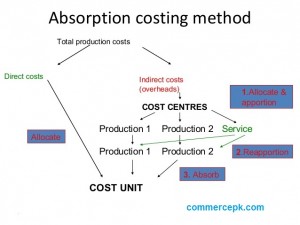
Absorption costing means that all of the manufacturing costs are absorbed by the units produced. In other words, we can say that the cost of a finished unit in inventory will include direct materials, direct labor, and both variable and fixed manufacturing overhead. Accordingly, absorption costing is also referred to as full costing or the full absorption method.

A product may absorb a wide range of fixed and variable costs. These costs are not recognized as expenses in the month when an entity pays for them. Instead, they remain in inventory as an asset until such time as the inventory is sold; at that point, they are charged to the cost of goods sold.

absorption costing method


Absorption Costing Components

Below are the following components of absorption costing:

Direct materials. Those materials that are included in a finished product.

Direct labor. The manufacturing factory labor costs necessary to build a product.

Variable manufacturing overhead. The costs to operate a manufacturing facility, which vary with production volume. Examples are supplies and electricity for production equipment.

Fixed manufacturing overhead. The costs to operate a manufacturing facility, which do not vary with production volume. Examples are rent and insurance.


You may also like to Read

  • What is Cost Accounting
  • What is Job Order Costing

Absorption Costing Method

The following method is required to complete a periodic job of costs to produced goods are:

Assign costs to cost pools. This is comprised of a standard set of accounts that are always included in cost pools, and which should rarely be changed.

Calculate usage. Determine the amount of usage of whatever activity measure is used to assign overhead costs, such as machine hours or direct labor hours used.

Assign costs. Divide the usage measure into the total costs in the cost pools to arrive at the allocation rate per unit of activity, and assign overhead costs to produced goods based on this usage rate.

Overhead Absorption

Absorbed overhead is manufacturing overhead that has been applied to products or other cost objects. Overhead is usually applied based on a predetermined overhead allocation rate. Overhead is over absorbed when the amount allocated to a product or other cost object is higher than the actual amount of overhead, while the amount is under absorbed when the amount allocated is lower than the actual amount of overhead.

For example, Bilal trader’s budgets for a monthly manufacturing overhead cost of Rs 200,000, which it plans to apply to its planned monthly production volume of 100,000 widgets at the rate of Rs, 2 per widget. In July, Bilal trader’s only produced 45,000 widgets, so it allocated just Rs. 180,000. Also, the actual amount of manufacturing overhead that the company incurred in that month was Rs. 196,000. Therefore, Higgins experienced Rs16,000 of under absorbed overhead.

In August, Bilal trader’s produced 120,000 widgets, so it allocated Rs. 240,000 of overhead. Also, the actual amount of manufacturing overhead that the company incurred in that month was Rs. 218,000. Therefore, Higgins experienced Rs. 22,000 of over absorbed overhead.

Filed Under: Cost Accounting Tagged With: Absorption Costing, What is Absorption Costing Method

What is Job Order Costing with Example

February 24, 2015 By Salman Qureshi

Job Order Costing:

Job order costing is a cost accounting system in which direct costs are traced and indirect costs are allocated to unique and distinct jobs instead of departments. It is appropriate for businesses that provide non-uniform customized products and services.

Job order costing is one of the two main cost accounting systems, the other being the process costing in which costs are traced and allocated first to different processes carried out in different departments and then to products and services. Many companies use costing systems that are a blend of features of both job-order costing and process costing systems.

Job Order Costing used by companies

Some of the companies that use Job Order Costing include:
1. Accounting, consulting and legal firms

2. Architects

3. Manufacturers of ships and airplanes

4. Book publishers

5. Movie producers

The nature of their work is such that they are interested in finding profitability of different jobs and hence they accumulate costs with reference to different jobs like audit engagement, consulting projects, books, movies, etc.

You may also like to Read:

  • What is Cost Accounting
  • Absorption Costing Method

Job order Costing Example:

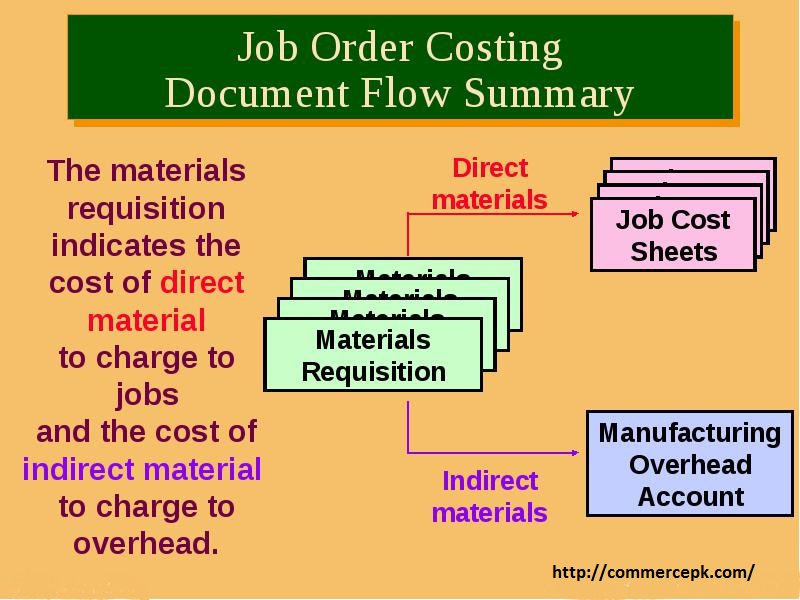
In a job order costing system, jobs are accounted for using the job-order cost sheet. The process involves the following steps:

  1. Identification of the job
  2. Tracing direct costs to the job
  3. Identifying the indirect costs i.e. manufacturing overheads and finding the cost allocation base for each cost.
  4. Applying the indirect costs to the job using the pre-determined allocation rate.

Finding total cost by summing up all the cost components.

Closing the under/over-applied manufacturing overheads to cost of goods sold/income statement.

Calculating revenue and profit.

job order costing
job order costing

Job Order Casting: Example: Journal Entries

Dynamic Systems Inc. (DS) received an order to manufacture a customized airplane for the official use of the president of Pakistan. DS will charge an amount equal to the cost of the airplane plus a 30% profit margin on cost to the government of Pakistan. The job code is FF04

Since the manufacture of the airplane is a one-off project, job-order costing is the most appropriate cost accumulation system. Let us post the required journal entries in the DS costing system.

  1. DS purchased raw materials (such as aluminum, fiber, etc.) at a cost of Rs.4 million.

Material inventory Rs.4,000,000

Material inventory Rs.4,000,000

Accounts payable Rs.4,000,000

  1. $2.8 million worth of raw materials were used in the project as direct materials.

Work in process—FF04 Rs.2,800,000

Inventories Rs.2,800,000

3. Rs.0.4 million worth of raw materials were used as indirect materials.

Manufacturing overheads Rs400,000

Inventories Rs.400,000

4.Total direct labor hours consumed on the job cost Rs.3 million. The amount is already paid.

Work in process—ff04 Rs.3,000,000

Cash Rs.3,000,000

5.Indirect labor hours relevant to the project cost
$1 million.
Manufacturing overheads Rs.1,000,000

Cash Rs.1,000,000

6.Other indirect costs yet to be paid were Rs.2.5 million.

Manufacturing overheads Rs.2,500,000

Accounts payable Rs.2,500,000

7.Manufacturing overheads are charged to jobs at 100% of direct labor cost i.e. Rs.3,000,000.

Work in process—FF04 Rs3,000,000

Manufacturing overheads Rs.3,000,000

8.The cost of FF04 is transferred from work in progress to finished goods on its completion at total cost of Rs.8,800,000 (=direct materials cost of Rs.2,800,000 plus direct labor cost of Rs.3,000,000 and applied manufacturing overheads of Rs.3,000,000).

Finished goods Rs.8,800,000

Work in process—FF04 Rs.8,800,000

9. Revenue is recorded at Rs.11,440,000 [= Rs.8,800,000 × 1.3].

Accounts receivable Rs.11,440,000

Revenue Rs.11,440,000

10.Actual manufacturing overheads are $3,900,000 (=indirect materials of $400,000 plus indirect labor of $1,000,000 and other overheads of $2,500,000). Applied manufacturing overheads are $3,000,000. The $900,000 worth of manufacturing overheads under-applied is taken to the cost of goods sold or income statement.

Cost of goods sold Rs.900,000

Manufacturing overheads Rs.900,000

Profit on FF04 is Rs.1,700,000 (=revenue of Rs.11,440,000 minus finished goods of Rs.8,800,000 and under-applied overheads adjustment of Rs.900,000).

Filed Under: Cost Accounting Tagged With: job order casting example, what is Job Order Costing

Difference between Financial and Management Accounting

November 22, 2014 By Salman Qureshi

Difference between Financial and Management Accounting:

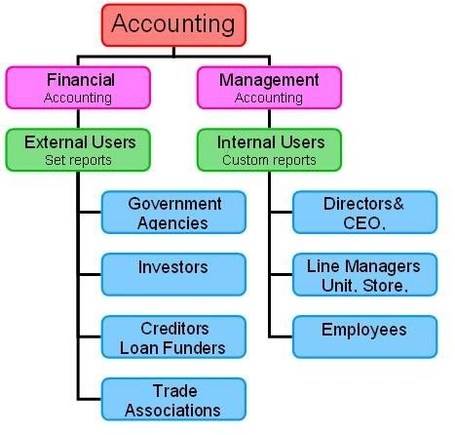
There are two broad types of accounting information:

  • Financial Accounts: geared toward external users of accounting information.
  • Management Accounts: aimed more at internal users of accounting information.

Although there is a difference in the type of information presented in financial and management accounts, the underlying objective is the same - to satisfy the information needs of the user.

Difference Between financial and management accounting

You may also Like to Read

  • What is Cost Accounting
  • What is Job Costing

The Key Difference Between Financial and Management Accounting are as follow;

Financial Accounting

Management Accounting

Financial accounts describe the performance of a business over a specific period and the state of affairs at the end of that period. The specific period is often referred to as the “Trading Period” and is usually one year long. The period-end date as the “Balance Sheet Date” Management accounts are used to help management record, plan and control the activities of a business and to assist in the decision-making process. They can be prepared for any period (for example, many retailers prepare daily management information on sales, margins and stock levels).
Companies that are incorporated under the Companies Act 1989 are required by law to prepare and publish financial accounts. The level of detail required in these accounts reflects the size of the business with smaller companies being required to prepare only brief accounts. There is no legal requirement to prepare management accounts, although few (if any) well-run businesses can survive without them.
The format of published financial accounts is determined by several different regulatory elements:

  • Company Law
  • Accounting Standards
  • Stock Exchange
There is no pre-determined format for management accounts. They can be as detailed or brief as management wish.
Financial accounts concentrate on the business as a whole rather than analysing the component parts of the business. For example, sales are aggregated to provide a figure for total sales rather than publish a detailed analysis of sales by product, market etc. Management accounts can focus on specific areas of a business’ activities. For example, they can provide insights into performance of:

  • Products
  • Separate business locations (e.g. shops)
  • Departments / divisions
Most financial accounting information is of a monetary nature Management accounts usually include a wide variety of non-financial information. For example, management accounts often include analysis of:- Employees (number, costs, productivity etc.)- Sales volumes (units sold etc.)

- Customer transactions (e.g. number of calls received into a call centre)

By definition, financial accounts present a historic perspective on the financial performance of the business Management accounts largely focus on analysing historical performance. However, they also usually include some forward-looking elements - e.g. a sales budget; cash-flow forecast.

Filed Under: Cost Accounting Tagged With: Difference between financial Accounting and management accounting, management accounting notes

  • Page 1
  • Page 2
  • Go to Next Page »

The Mind Behind Commerce Pk

Salman Qureshi is Researcher & passionate Blogger, he loves to write on Commerce & Management Sciences subjects to assist students, Hope you guys will like his effort.


  • About Me
  • Privacy Policy
  • Copy Rights
  • Disclaimer
  • Publish Your Article
  • Contact Us
  • Discussion Forum
  • Ask Question

Copyright © 2024